

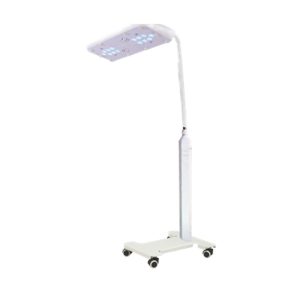

LED Neonatal Phototherapy Stand
- Easy to operate.
- Low power consumption (12 W) compared to any conventional phototherapy system (120 W).
- LED’s emitting blue light in 450-470 nm. Spectrum matching peak absorption wavelength (458 nm.)
- at which bilirubin is broken down. Do not emit light in infrared radiation range
- reduction the risk of fluid loss.
- Long life > 20,000 hrs.
- Negligible Maintenance cost.
- Intensity: > 25 μW/cm2 / nm.
- Heavy duty mobile stand with height adjustment facility & easy swivelling box when stand is to be used.
- in conjunction with radiant warmer or infant trolley.
- Mounted on castors for easy mobility.
- S. Fabrication with powder coated paint.
- Time Totalizer (Optional).
Features:
- Compact, Portable & Easy to Carry.
- Low Power consumption (12 W).
- Long life > 20,000 hrs.
- Irradiance: > 25 μW/cm2 / nm.
- Can be used separately in mother bed / in trolly.
- S. Fabrication with powder coated paint.
- Time Totalizer (Optional).
- Operation Voltage: 100-250V AC, 50Hz.
- LED’s emitting blue light in 450-470 mm.
- Specturm matching peak absorption wavelength (458 nm.) at which bilirubin is broken down Do not emit light in infrared radiation range reduction the risk of fluid loss.
What are phototherapy units?
Newborns often suffer from jaundice, especially in cases of neonatal hyperbilirubinemia, and this condition is treated using phototherapy equipment. These devices break down bilirubin in the infant’s blood by means of light therapy, thereby reducing levels and preventing complications. Phototherapy units for neonatal care are crucial in the control of jaundice as well as improving health outcomes among infants.
Characteristics of Phototherapy Units
- Light Source: These devices make use of powerful fluorescent lamps or LEDs with different hues for them to be effective against jaundice.
- Variable settings: Depending on what works best for each patient individually, the intensity as well as duration can be adjusted accordingly.
- Temperature control: By maintaining stability around them at all times this ensures that babies are kept warm throughout their stay within such systems thereby providing comfort too.
- Protective Shields: Babies’ eyes are shielded from bright lights while receiving treatment to protect them, which should work effectively too.
Working of Phototherapy Units?
The function principle behind a phototherapy unit lies in exposing a newborn child to some particular kind of light so as to breakdown bilirubin found in his/her bloodstream. This light usually comes from high-intensity fluorescent or LED bulbs; it helps change bilirubin into a form that can easily be excreted by liver cells. For each patient, healthcare providers may adjust settings like duration and intensity, thus making sure treatment is effective enough but still comfortable for the baby’s skin. However, eyes must also be protected, hence shields are used to reflect lights where needed most without affecting them directly.
Advantages of Phototherapy Units
- Efficient Treatment: Speedily reduces bilirubin levels, leading to less severe cases with higher chances for full recovery;
- Non-Invasive Approach: Provides safe ways through which one can handle neonatal jaundice without necessarily having any contact whatsoever;
- Adjustable Settings: Can be aligned with different treatments depending on various requirements from one child to another.
- Ease of Use: Modern units have been made more user-friendly so that healthcare personnel can easily operate them while monitoring their patients’ treatment.
Phototherapy units are important in the treatment of neonatal jaundice, which provides a good and non-invasive way for healthcare providers to care for infants.
When choosing reliable phototherapy solutions, it is necessary that medical practitioners opt for those made by reputable companies. Microsil India is a Phototherapy unit Manufacturer in India producing quality instruments with excellent customer care services aimed at giving the best possible attention to ensuring maximum benefits are achieved during their treatment process.